FORMIAX


Mathematical calculators Physical calculators Economic calculators Other calculators


Triangle properties


Interactive explorer — grab vertex A, B or C and drag it. The angles and the sides are recalculated live.
Photo
Triangle
Formula & notes

α + β + γ = 180°

α′ = 180° − α = β + γ

α′ + β′ + γ′ = 360°

α, β, γ = interior angles at vertices A, B, C

α′, β′, γ′ = exterior angles (supplements to 180°)

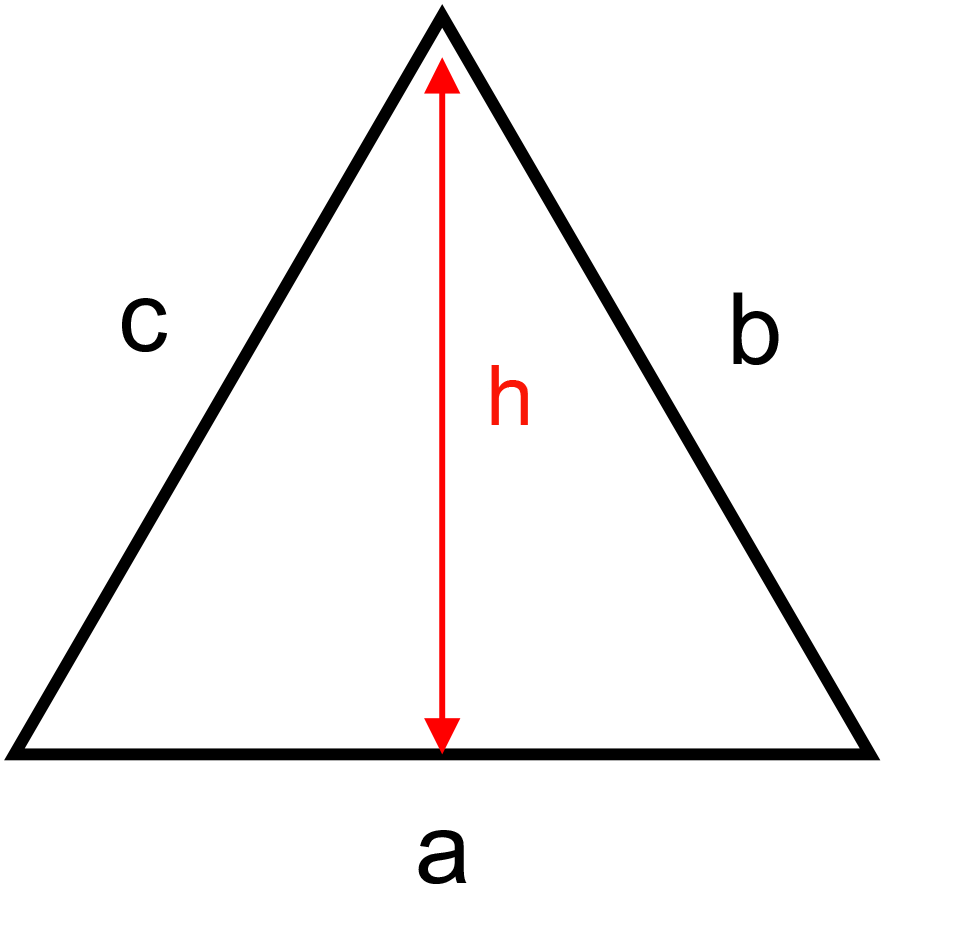
a = BC, b = AC, c = AB (sides)

triangle inequality: a + b > c, a + c > b, b + c > a

What is it?

A triangle is a plane figure with three vertices and three sides. No matter how we draw it, the sum of its interior angles is always exactly 180°. Thanks to that it is enough to know two angles and the third one is found by subtracting from 180°.

If one of the sides is extended beyond a vertex, an exterior angle appears. It is the supplement of the interior angle to 180° and, by the exterior angle theorem, it equals the sum of the two interior angles at the remaining vertices. The sum of all three exterior angles is 360°. For a triangle to be constructible at all, the triangle inequality must hold: the sum of any two sides is greater than the third side.

Interactive graph

Drag vertices A, B, C exterior anglesre-center

Angles and sides
Alpha (A)
+
Beta (B)
+
Gamma (C)
=

✓ The sum of the interior angles is always exactly 180°

Alpha′
+
Beta′
+
Gamma′
=

✓ The sum of the exterior angles is always 360°  ·  α′ = β + γ

SideLengthValue
Side a (BC)
Side b (AC)
Side c (AB)
1. Sum of the interior angles
  • Rule: α + β + γ = 180° holds for every triangle.
  • Why: if we draw a line through one vertex parallel to the opposite side, the three angles fit together into a straight angle.
  • Consequence: if two angles are known, the third one is 180° − (α + β).
  • Type by angles: all angles smaller than 90° → acute; one equal to 90° → right; one larger than 90° → obtuse.
2. Exterior angles
  • How it appears: by extending a side beyond a vertex; together with the interior angle it forms a straight angle.
  • Relation: α′ = 180° − α (the same for β′ and γ′).
  • Exterior angle theorem: α′ = β + γ — the exterior angle equals the sum of the two remote interior angles.
  • Sum: α′ + β′ + γ′ = 540° − 180° = 360°, and that in every triangle.
3. Triangle inequality
  • Rule: the sum of any two sides must be greater than the third side.
  • Conditions: a + b > c, a + c > b, b + c > a — all three must hold at the same time.
  • If it fails: such a triangle cannot be constructed, the sides simply never meet.
  • Type by sides: all equal → equilateral; two equal → isosceles; all different → scalene.
Worked example
Problem 1: In triangle ABC we know the angles α = 55° and β = 70°. Find the size of the third angle γ.
Solution: γ = 180° − (55° + 70°) = 180° − 125° = 55° → since α = γ, it is an isosceles triangle.
Problem 2: Decide whether a triangle with sides a = 4 cm, b = 3 cm and c = 8 cm can be constructed.
Solution: a + b = 4 + 3 = 7 cm, which is not greater than 8 cm. The triangle cannot be constructed.
Problem 3: The interior angle α = 62°. How large is the exterior angle α′ at the same vertex?
Solution: α′ = 180° − 62° = 118°.
Problem 4: In a triangle β = 48° and γ = 71°. Find the exterior angle α′ at vertex A.
Solution (exterior angle theorem): α′ = β + γ = 48° + 71° = 119°. Check: α = 180° − 119° = 61° and 61° + 48° + 71° = 180° ✓
You might be interested

Video
Video coming soon
Frequently asked questions
How much is the sum of the interior angles of a triangle?
In every triangle exactly 180°: α + β + γ = 180°. It holds without exception, so when two angles are known the third one is found as 180° − (α + β).
What is an exterior angle of a triangle?
The angle that appears when a side is extended beyond a vertex. Together with the interior angle at that vertex it forms a straight angle, so α′ = 180° − α. The sum of all three exterior angles is 360°.
What does the exterior angle theorem say?
The exterior angle equals the sum of the two interior angles at the remaining vertices: α′ = β + γ. It follows directly from the 180° sum, because α′ = 180° − α = (α + β + γ) − α.
Why can some triangles not be constructed?
Because they break the triangle inequality — the sum of two sides must be greater than the third one. If for example a + b ≤ c, the shorter sides never meet during the construction and no figure appears.
Practice problems

Solve it step by step — the next step unlocks only after a correct answer. You can type decimals with a dot or a comma.


Formiax