Spherical layer - area and volume
Interactive calculator — drag or enter the values and you instantly see the result, together with the formula and a live calculation.
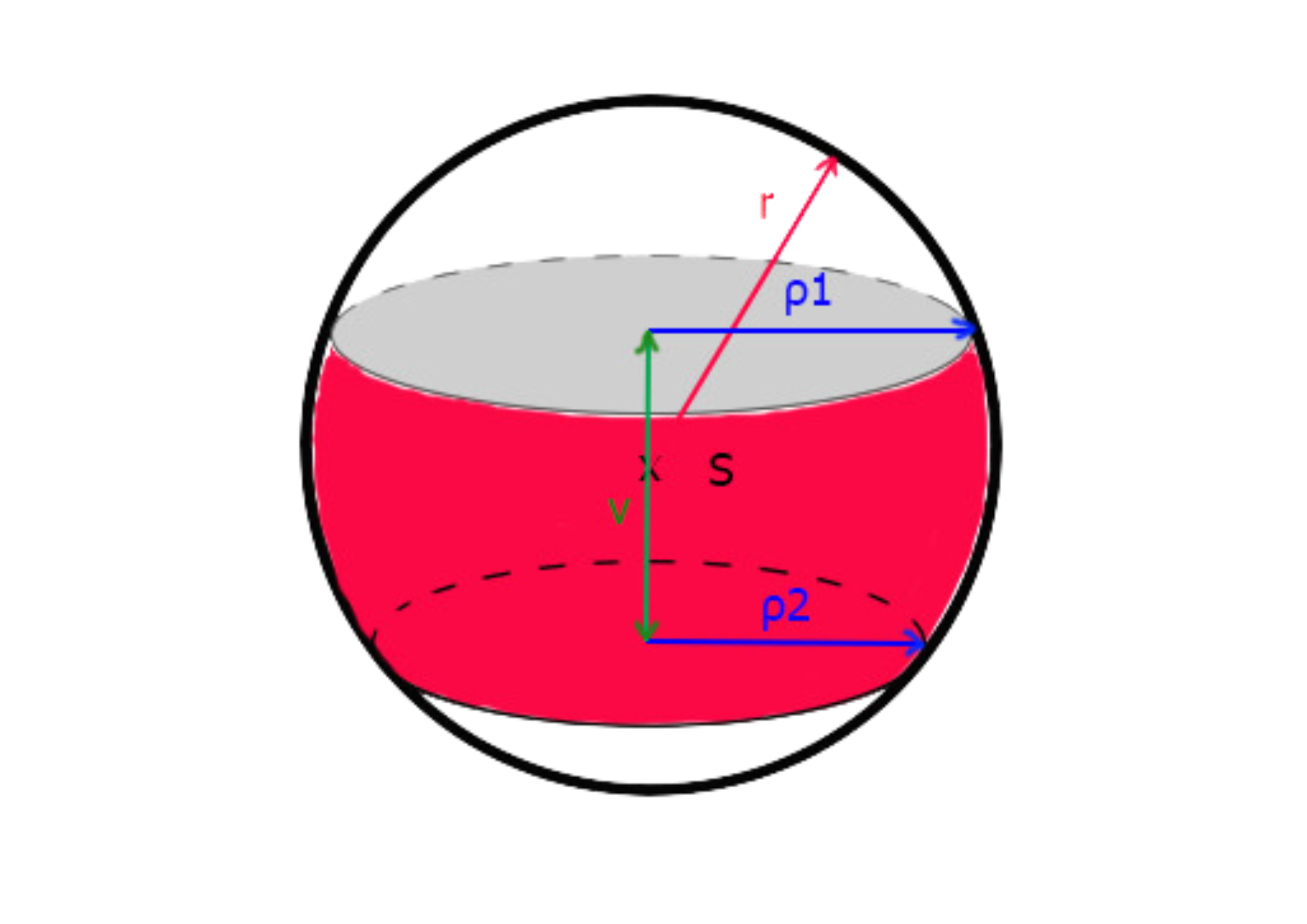
S = surface area
V = volume
r = radius of the sphere
ρ1 = base radius ρ1
ρ2 = base radius ρ2
v = layer height
A spherical layer is the solid that arises when a sphere is cut by two parallel planes σ1 and σ2, both of which are less than the radius r away from the centre S of the sphere. The planes cut two circles out of the sphere, with radii ρ1 and ρ2, which form the bases of the layer, and the part of the sphere between them is exactly the spherical layer. The curved lateral surface of this layer is called a spherical zone, and it is the patch of the spherical surface bounded by two parallel circles. If one of the cutting planes only touches the sphere, both bases merge into a single one and instead of a layer we get a spherical segment topped by a spherical cap.
An interesting property of the spherical zone is that its area depends only on the radius of the sphere and on the layer height v, that is on the perpendicular distance between the two planes, and not on where exactly the sphere is cut. Two equally high zones on the same sphere therefore always have the same surface area, even if one of them lies at the equator and the other close to a pole. Spherical layers turn up when calculating the surface area and volume of barrel-shaped tanks, domes, floats or lenses, and in geography when determining the areas of climate belts between two parallels. That makes it not only a school exercise, but also a practical tool in engineering, construction and astronomy.
Total surface area S
–
Spherical layer volume V
–
Spherical zone (2πrv)
–
Grab the blue handle and drag it up or down – it changes the layer height v Center
What do ρ1, ρ2, r and v mean?
How do you calculate the volume of a spherical layer?
What is the area of a spherical zone (the lateral surface)?
What is the difference between a spherical layer and a spherical segment?
Solve it step by step — the next step unlocks only after a correct answer. You can type decimals with a dot or a comma.
