Regular polygon - perimeter and area
Online calculator — enter the values and get the result instantly, with the formula and a worked example.
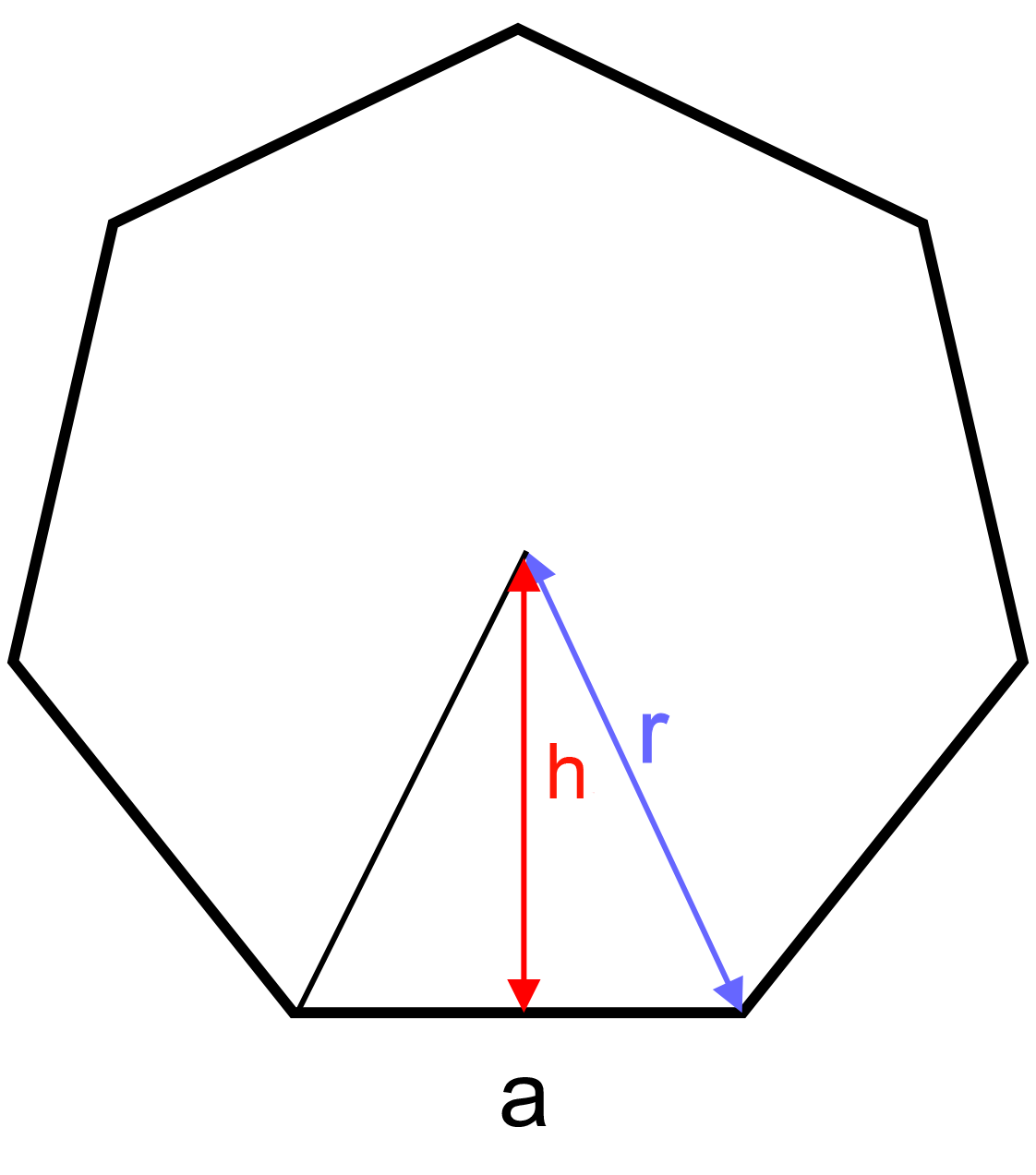
A = area
P = perimeter
a = side
h = height
r = radius
n= number of sides
A regular polygon is a flat, closed shape whose sides are all the same length and whose interior angles are all equal. Because of this double symmetry, it looks the same when rotated around its centre and can be reflected onto itself, giving it a balanced, harmonious appearance. Every regular polygon can be inscribed in a circle that passes through all its vertices and circumscribed about a circle that touches every side, and these two circles share the same centre. Familiar examples include the equilateral triangle, the square, the regular pentagon and the regular hexagon, each named for its number of sides. As the number of sides grows, a regular polygon looks more and more like a circle, which is why mathematicians historically used many-sided polygons to estimate the value of pi. These shapes are a cornerstone of geometry and turn up constantly in the real world, from the honeycomb cells built by bees to nuts and bolts, floor tiles and traffic signs. Their predictable structure also makes them essential in design, architecture and computer graphics, where regularity and symmetry are prized.
Area
–
Perimeter
–
Interior angle
–
| Apothem (inradius) r | – |
| Circumradius R | – |
| Number of sides n · side a | – · – |
Drag the blue vertex to change the side length; change the number of sides in the calculator. Re-center
Solve it step by step — the next step unlocks only after a correct answer. You can type decimals with a dot or a comma.
