Triangle - perimeter
Online calculator — enter the values and get the result instantly, with the formula and a worked example.
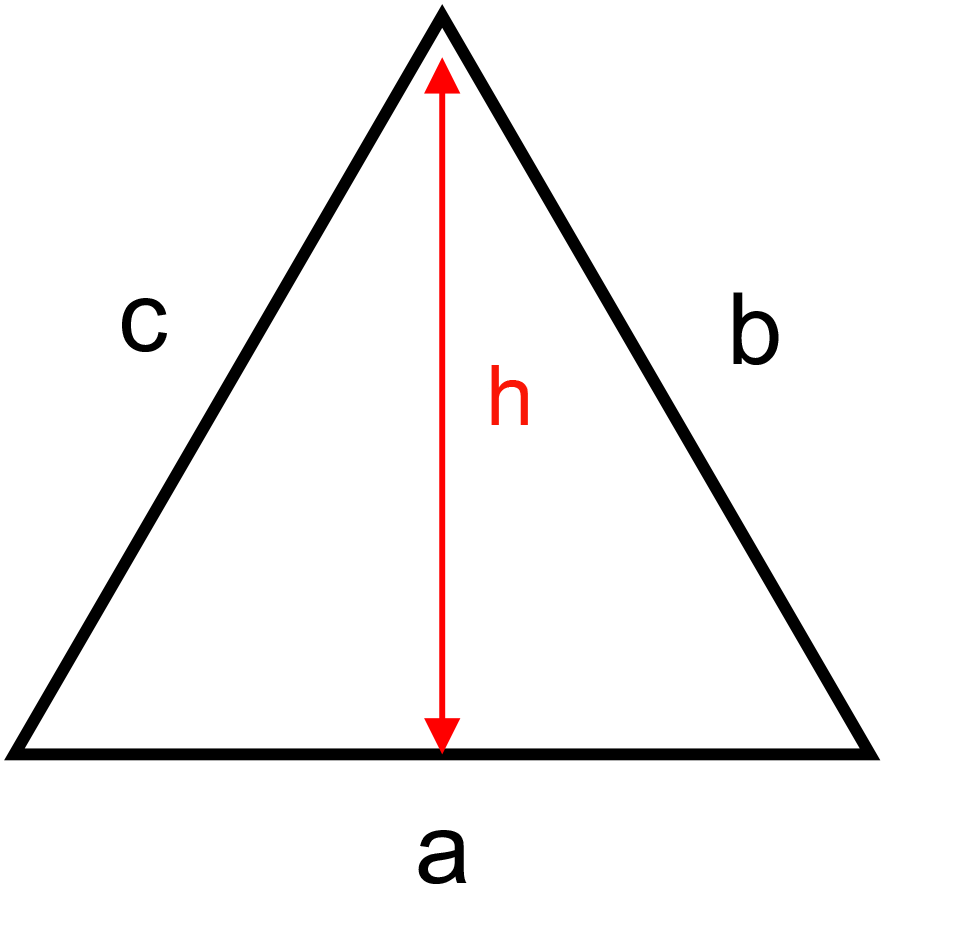
P = perimeter
a, b, c = sides
h = height
The perimeter of a triangle is the total distance around its outer boundary, found simply by adding the lengths of its three sides. Because a triangle is a closed figure with three edges and three vertices, its perimeter measures exactly how far you would travel walking once around the whole shape. The result is always a length, so it is expressed in linear units such as centimetres, metres, or inches, never in square units. The type of triangle affects how the sides relate: an equilateral triangle has all three sides equal, so its perimeter is three times one side, while an isosceles triangle has two equal sides and a scalene triangle has three different sides. A key property, the triangle inequality, guarantees that any two sides together must be longer than the third, otherwise the three lengths could never close up into a real triangle. In practice the perimeter tells you how much material bounds a region, which is why it is used to measure fencing for a triangular plot, edging or trim for a shape, or the framework of a truss. Builders, surveyors, designers, and students all rely on it whenever the length of an outline matters more than the area it encloses. Its simplicity makes the perimeter one of the first geometric quantities we learn, yet it stays useful in surprisingly advanced work.
Triangle perimeter
–
The triangle is drawn to scale from its sides
Solve it step by step — the next step unlocks only after a correct answer. You can type decimals with a dot or a comma.
