Ellipse - perimeter and area
Online calculator — enter the values and get the result instantly, with the formula and a worked example.
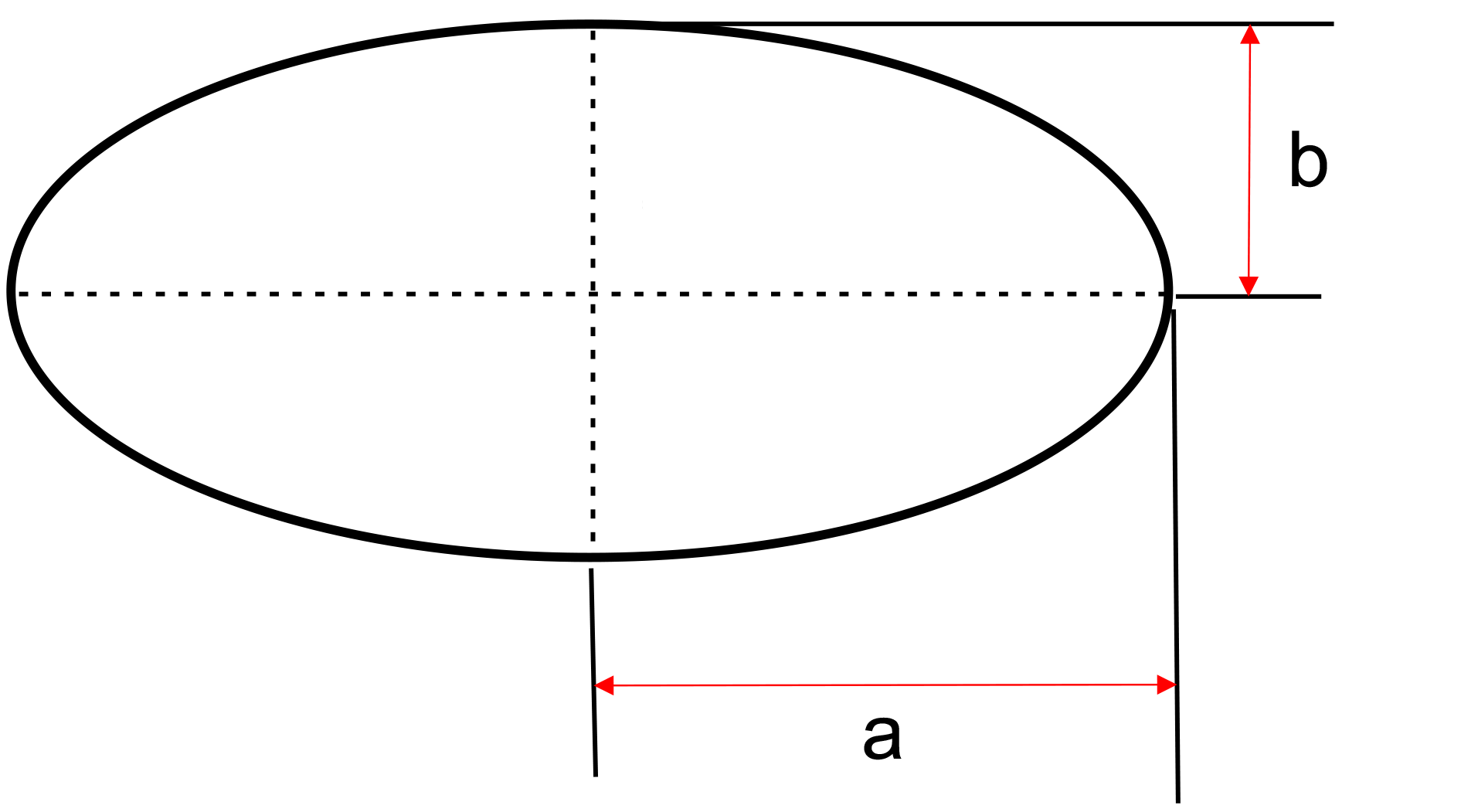
A = area
P = perimeter
a = long half axis
b = short half axis
An ellipse is a closed, oval-shaped curve made up of all the points whose combined distance from two fixed points, called the foci, stays constant. This defining property gives the ellipse its perfectly balanced, elongated form, which can be thought of as a circle that has been stretched in one direction. Its longest span, passing through both foci, is the major axis, while the shortest span perpendicular to it is the minor axis, and half of each is the semi-major axis a and the semi-minor axis b. When the two foci merge into a single point, the ellipse becomes a circle, so a circle is really just a special case of an ellipse. How stretched the shape is can be described by its eccentricity, a number between 0 and 1 that measures how far it departs from a perfect circle.
Ellipses appear throughout nature and technology, most famously in astronomy: the planets travel around the Sun along elliptical orbits, a discovery captured in Kepler's first law. They also show up in engineering and architecture, from gears and elliptical arches to the whispering galleries where a sound made at one focus is reflected precisely to the other. Because of these rich properties, the ellipse is a cornerstone of geometry and a shape well worth understanding.
Ellipse area
–
Circumference (≈)
–
Major axis 2a
–
Semi-major axis a
–
Semi-minor axis b
–
The ellipse circumference has no simple exact formula — the value shown is approximate (the same approximation as in the example below).
Drag the right point (semi-axis a) and the top point (semi-axis b) Re-center
Solve it step by step — the next step unlocks only after a correct answer. You can type decimals with a dot or a comma.
