Rhombus - perimeter and area
Interactive calculator — drag the diagonals or type them in and see the result straight away, with the formula and a live calculation.
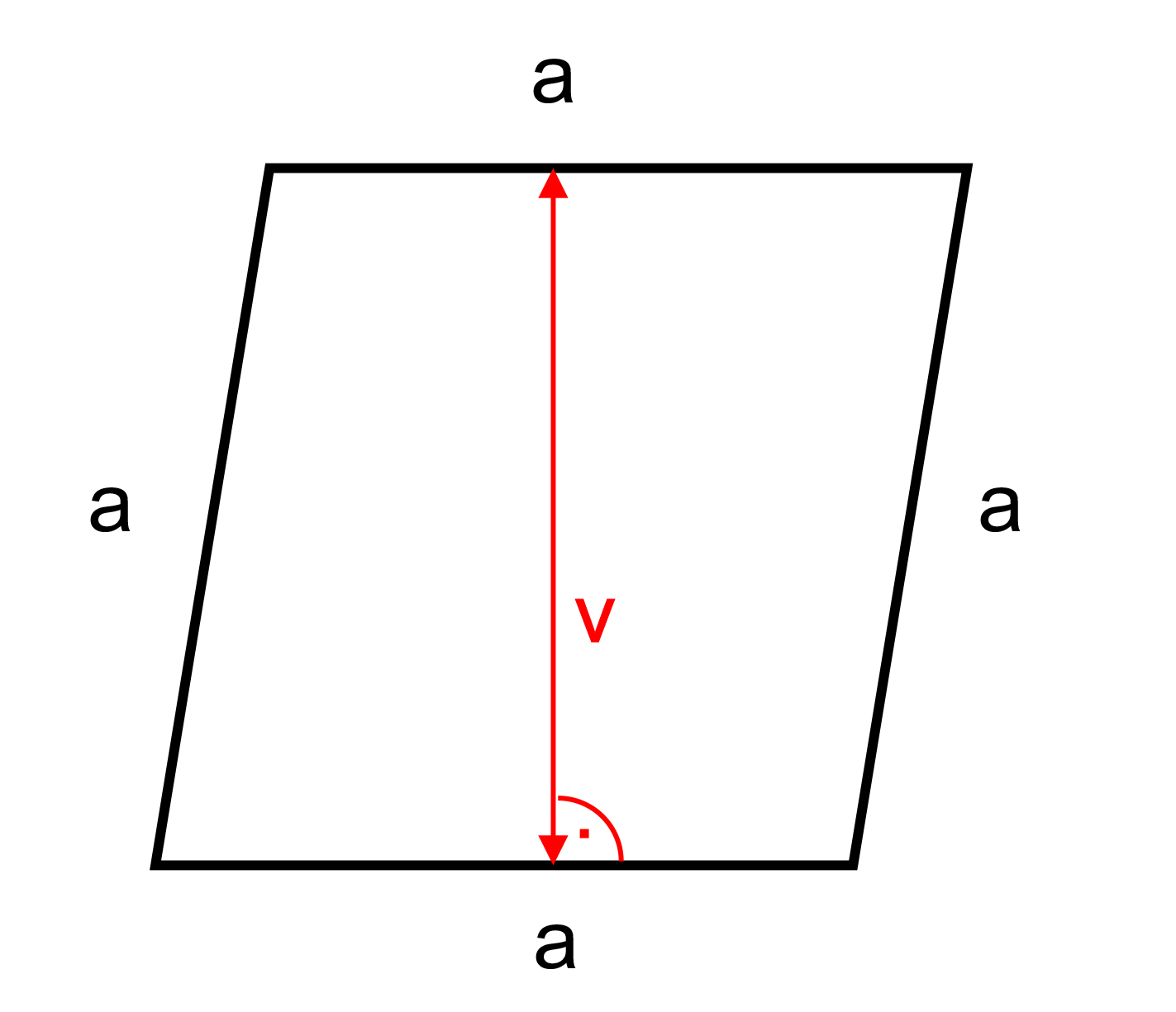
A = area
P = perimeter
a = side "a"
v = height
e = diagonal "e"
f = diagonal "f"
A rhombus is a quadrilateral whose four sides all have the same length, which is why it belongs to the family of parallelograms. Its opposite sides are parallel to each other, while adjacent sides are not. Opposite angles of a rhombus are equal and any two adjacent angles always add up to 180 degrees. What makes the shape special is that its diagonals are perpendicular to each other and bisect one another, and each of them also splits the vertex angles it passes through into two equal parts. A square can be understood as a particular case of the rhombus, one that additionally has all of its angles right. Thanks to this symmetry a rhombus has two axes of symmetry, running exactly along its diagonals.
We come across this shape more often than it might seem: the diamonds on playing cards are rhombi, and so are many floor tiles, traffic and warning signs, and the patterns woven into mesh and fabric. In engineering practice the shape is used by so-called rhombic linkages, and it also turns up in crystallography when lattices are described. Knowing its properties therefore pays off not only in school geometry, but also in design, construction and engineering.
Rhombus area
–
Perimeter
–
Side a
–
Height v
–
Diagonals e · f
–
Grab the end of diagonal e or f and drag it Re-center
How do you calculate the area of a rhombus?
How do you calculate the perimeter of a rhombus?
How do you calculate the side of a rhombus from its diagonals?
How does a rhombus differ from a square?
Solve it step by step — the next step unlocks only after a correct answer. You can type decimals with a dot or a comma.
