Pyramid (square based) - area and volume
Online calculator — enter the values and get the result instantly, with the formula and a worked example.
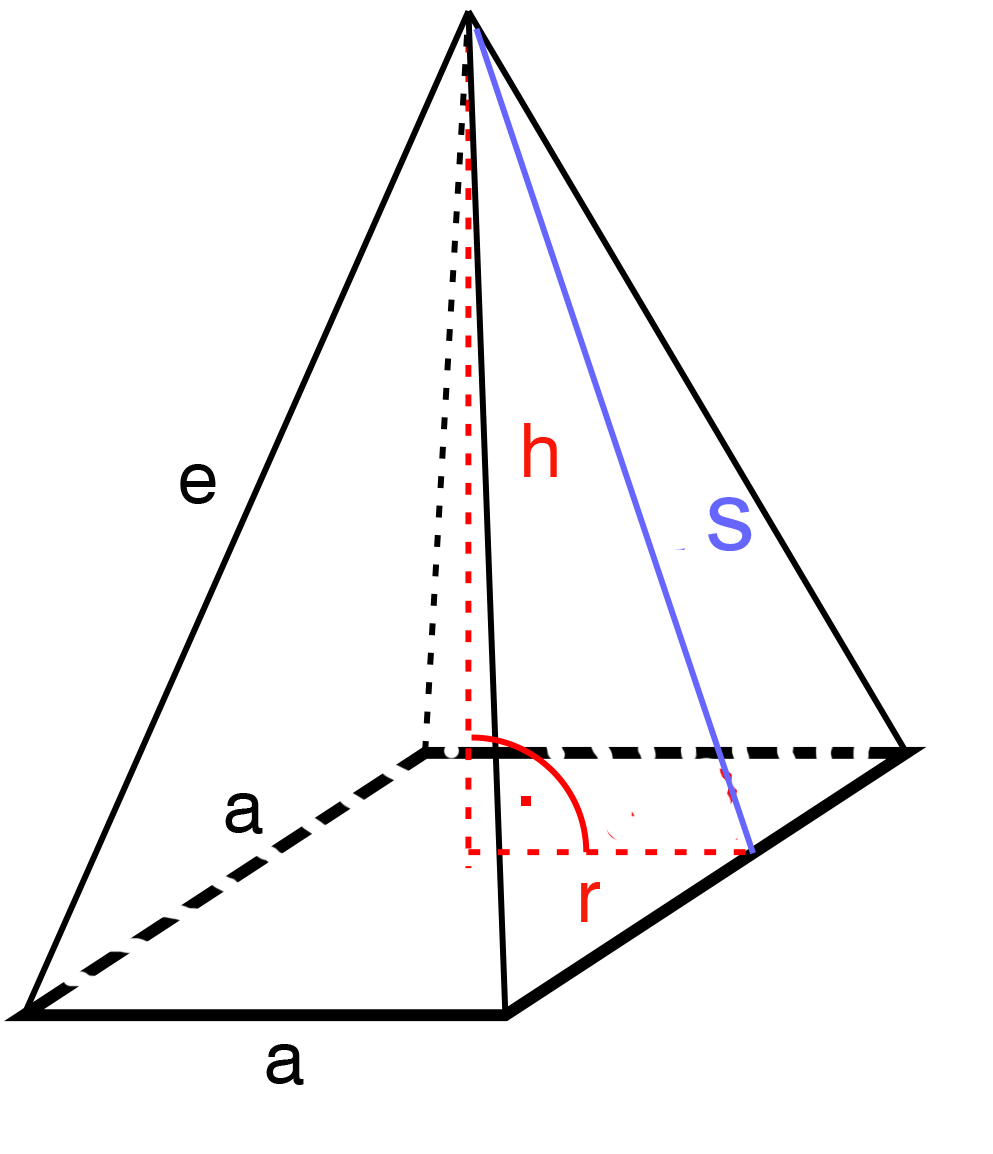
A = Area
V = volume
a = side "a"
h = height
s = slant triangle height
BA = basement area
LA = lateral area
A square-based pyramid is a three-dimensional solid whose base is a square and whose four triangular faces rise from the base edges to meet at a single point called the apex. It therefore has 5 faces, 8 edges and 5 vertices, and when the apex sits directly above the centre of the square it is called a right pyramid, which is perfectly symmetrical. Two heights matter for this shape: the vertical height, measured straight from the centre of the base to the apex, and the slant height, measured along a triangular face from the apex to the midpoint of a base edge. Its volume equals one third of the base area multiplied by the vertical height, so a pyramid always holds a third of the prism that shares the same base and height. Its surface area is the sum of the square base and the four identical triangular faces. Square-based pyramids appear throughout architecture and history, most famously in the pyramids of Egypt, and are still used today in rooftops, monuments and packaging design.
Volume V
–
Surface area S
–
Slant height s
–
| Base area BA | – |
| Lateral surface LA | – |
Drag a base corner (a) or the apex (h) Re-center
Solve it step by step — the next step unlocks only after a correct answer. You can type decimals with a dot or a comma.
