Cosine
Online calculator — enter the values and get the result instantly, with the formula and a worked example.
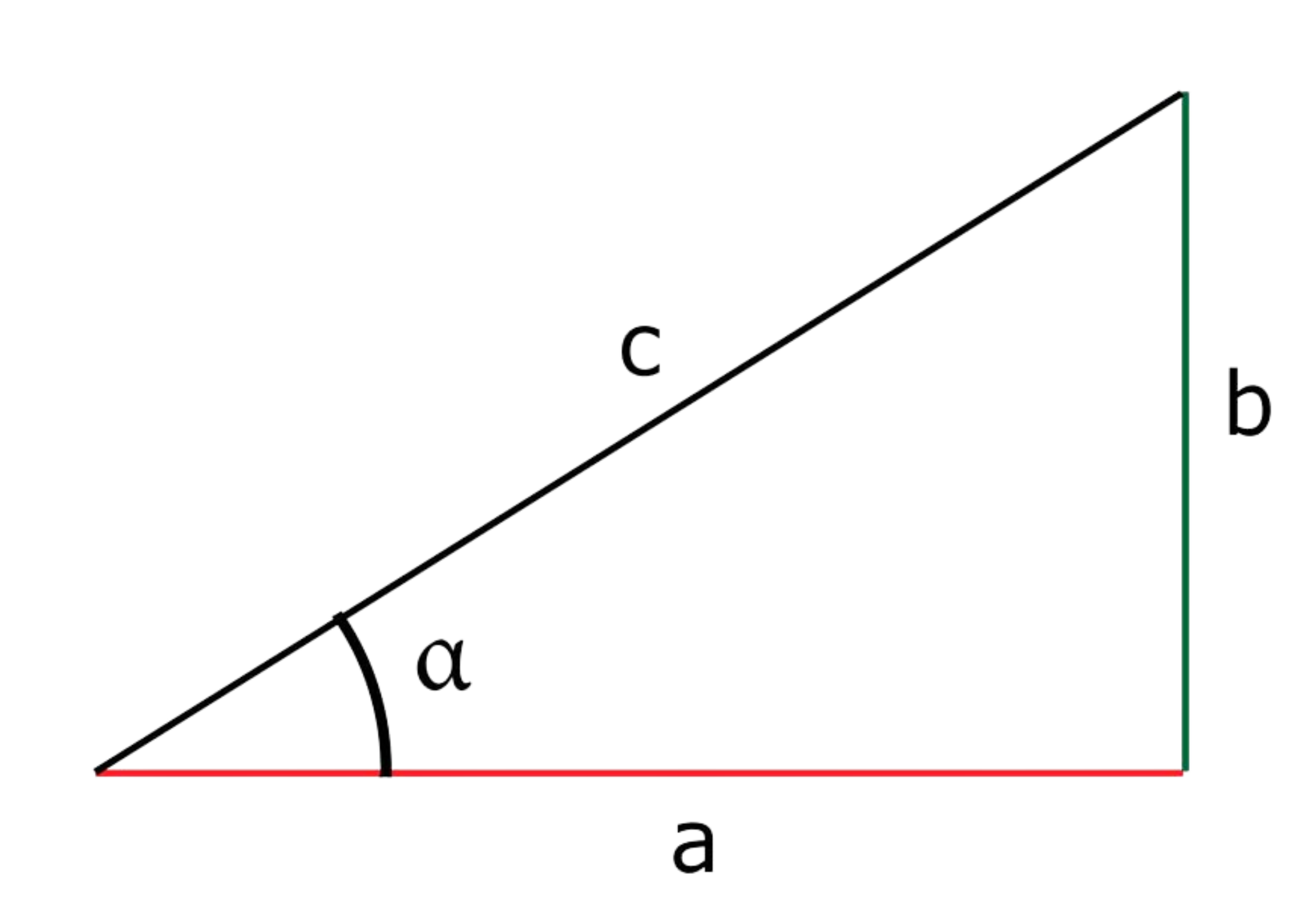
α = angle alpha
a = side "a"
b = side "b"
c = side "c"
The cosine of an angle is one of the fundamental trigonometric functions, defined in a right triangle as the ratio of the length of the side adjacent to the angle to the length of the hypotenuse. More generally, it is described by the unit circle, where the cosine of an angle equals the horizontal (x) coordinate of the point where the angle's ray meets the circle. Its values always lie between -1 and 1, and the function is periodic, repeating every 360 degrees, or 2π radians. Cosine is an even function, meaning that the cosine of an angle and its negative are identical, and it is simply the sine function shifted by 90 degrees. It reaches its maximum of 1 at 0 degrees and its minimum of -1 at 180 degrees, passing through zero at 90 and 270 degrees.
Cosine is indispensable across science and engineering: it appears in the law of cosines for solving triangles, in the dot product that measures the angle between vectors, and in describing oscillations and waves in physics. Fields such as navigation, surveying, computer graphics, and signal processing all rely on it to relate angles to distances and to break motion into components. Because of this versatility, mastering cosine is a cornerstone of trigonometry and a gateway to much of applied mathematics.
cos(θ)
–
Drag the point around the circle — or enter an angle
Solve it step by step — the next step unlocks only after a correct answer. You can type decimals with a dot or a comma.
