Circle segment - perimeter and area
Online calculator — enter the values and get the result instantly, with the formula and a worked example.
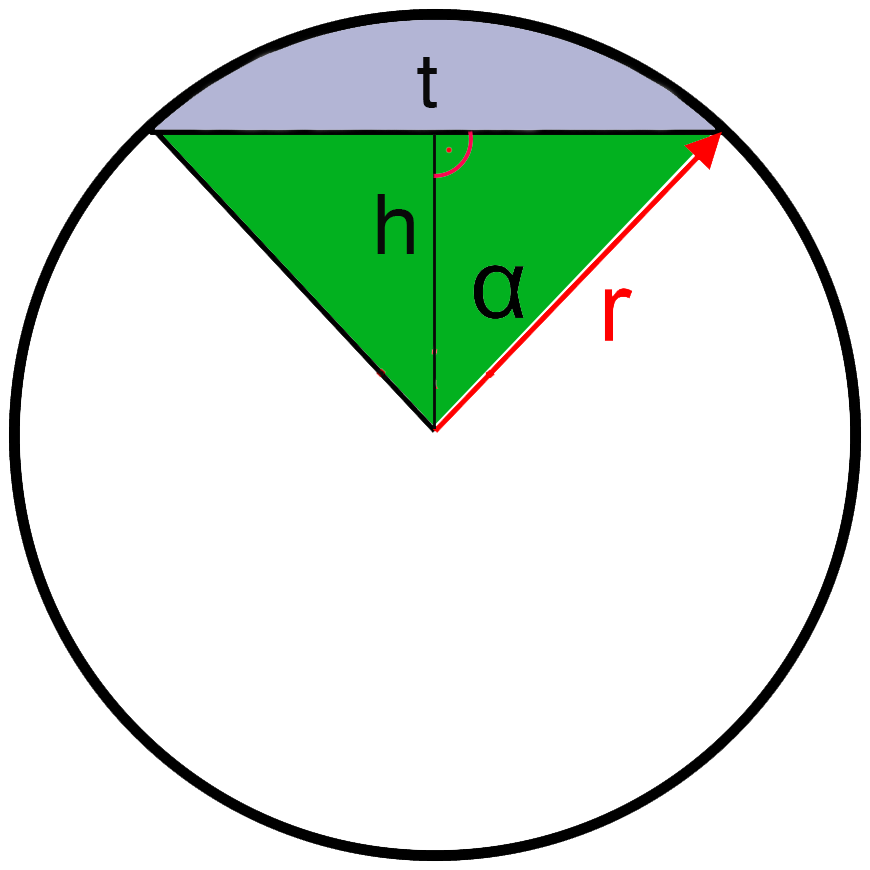
A = area
P = perimeter
α = angle
r = radius
t = chord
A circle segment is the region of a circle bounded by a chord and the arc that connects the same two endpoints. In other words, if you draw a straight line across a circle, it slices off a curved piece on each side, and each of those pieces is a segment. Any chord creates two segments: the smaller one is called the minor segment and the larger one the major segment, and together they fill the whole disc. Unlike a circular sector, a segment does not reach the centre of the circle, so its shape is defined entirely by the chord and the arc. Its size depends on just two quantities, the radius and the central angle spanning the arc, and from these the chord length, arc length, and the height of the segment (the sagitta) all follow. A useful way to picture it is as a circular sector with the triangle to the centre cut away, which is exactly how its area is found. Circle segments appear surprisingly often in the real world, from the cross-section of liquid in a partly filled horizontal tank or pipe to arched windows, bridge arches, and machine parts. Being able to compute their area and perimeter therefore matters in engineering, architecture, and design whenever curved surfaces need to be measured.
Segment area
–
Perimeter
–
Chord
–
Arc length
–
Sagitta (height)
–
| Radius r | – |
| Central angle α | – |
Drag the blue dot around the circle (angle α) · the orange dot sets the radius r
Solve it step by step — the next step unlocks only after a correct answer. You can type decimals with a dot or a comma.
