Spherical cap - area and volume
Online calculator — enter the values and get the result instantly, with the formula and a worked example.
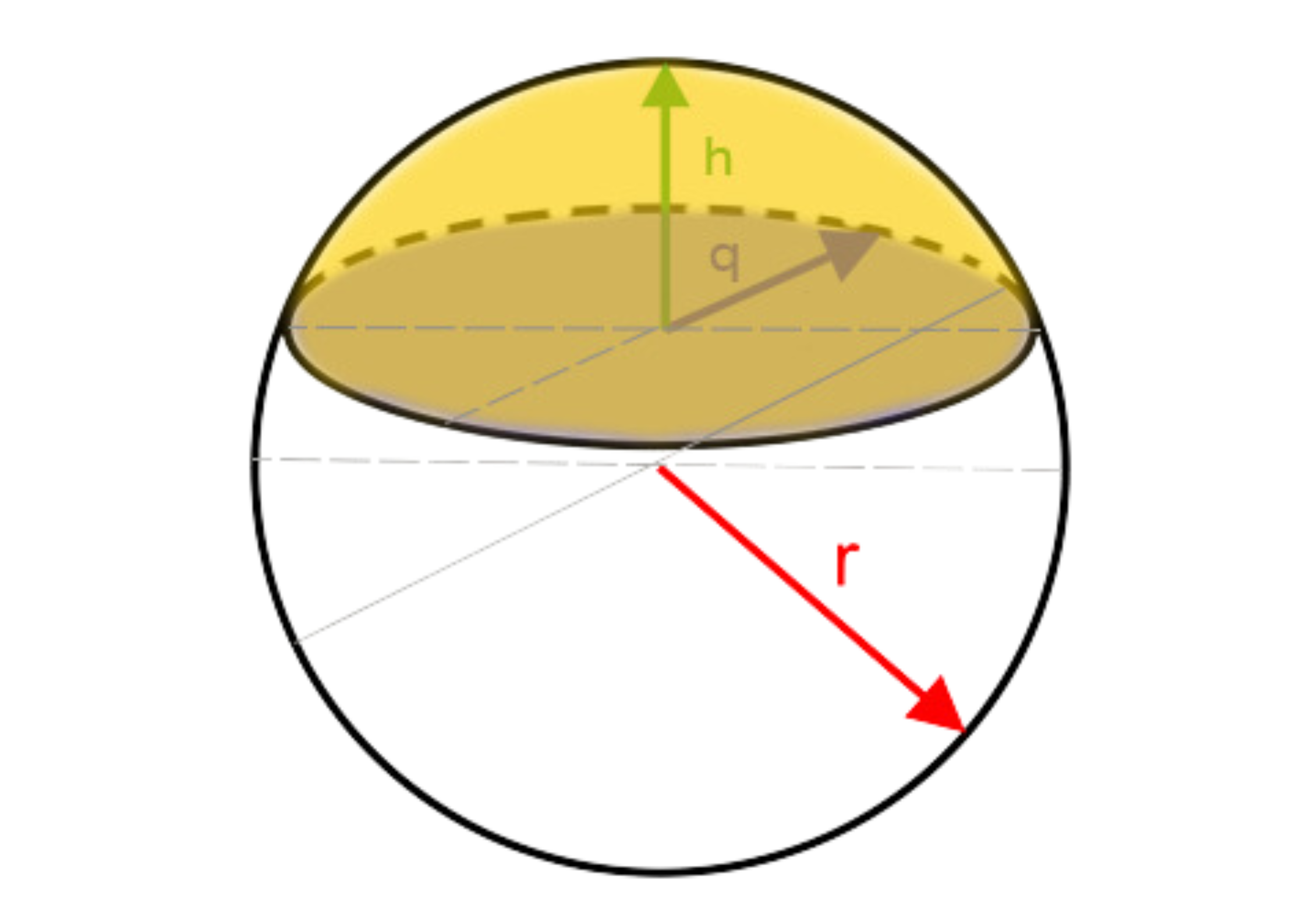
A = Area
V = volume
q = basement radius
r = radius
h = height
A spherical cap is the portion of a sphere that lies on one side of a plane cutting through it, like the piece you would slice off the top of an orange. Its base is a flat circular disk, and its curved surface is simply a patch of the original sphere. Two measurements describe it completely: the radius (r) of the sphere it was cut from, and the height (h), the perpendicular distance from the flat base to the highest point of the dome. When the cutting plane passes exactly through the centre, the cap becomes a hemisphere, which is the largest possible cap for a given sphere. This simple, dome-like shape appears throughout the physical world and turns out to be surprisingly useful.
Spherical caps show up in architecture and engineering whenever curved roofs, domes, or arched ceilings are designed, and they help estimate the material and interior space of such structures. Engineers use them to model the fluid held in the rounded bottom or top of a tank, while opticians rely on cap geometry to describe the curvature of lenses and mirrors. They also appear in everyday objects such as contact lenses, watch glasses, and the domed lids of containers. Understanding the spherical cap therefore bridges pure geometry and a wide range of practical, real-world calculations.
Spherical cap volume
–
Curved surface (cap) 2πrh
–
Total surface area
–
| Base radius ρ | – |
| Base area πρ² | – |
| Cap height h | – |
Drag the blue handle vertically (changes the cap height h) Re-center
Solve it step by step — the next step unlocks only after a correct answer. You can type decimals with a dot or a comma.
