Tangent
Online calculator — enter the values and get the result instantly, with the formula and a worked example.
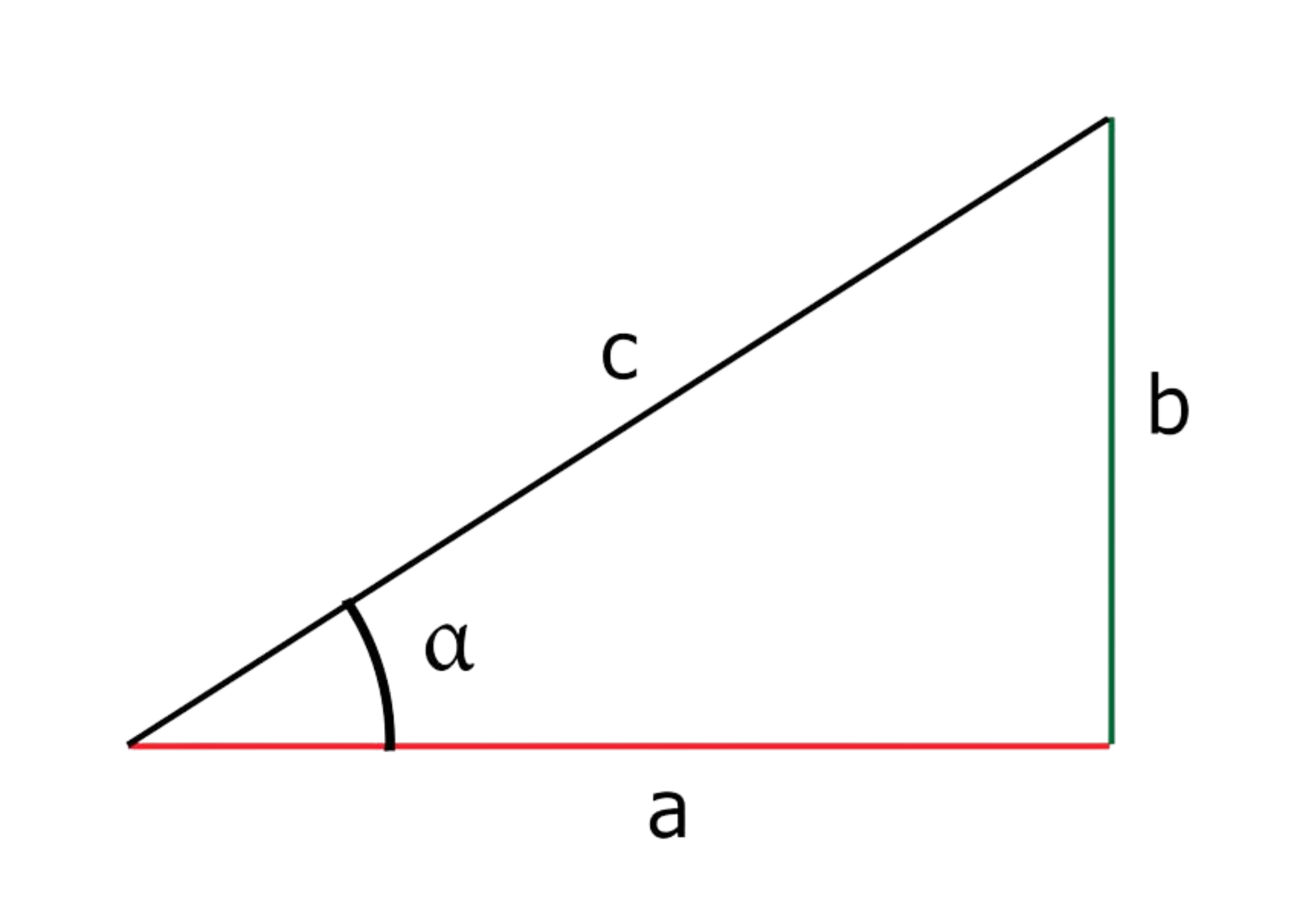
α = angle alpha
a = side "a"
b = side "b"
c = side "c"
The tangent of an angle is one of the three basic trigonometric functions, and in a right triangle it equals the ratio of the length of the side opposite the angle to the length of the side adjacent to it. It can also be understood as the ratio of the sine to the cosine of the same angle, which is why it is undefined wherever the cosine equals zero, such as at 90 degrees. Unlike the sine and cosine, whose values always stay between minus one and one, the tangent can take any real value and grows without bound as the angle approaches a right angle. Its graph is periodic, repeating every 180 degrees, with vertical asymptotes at those points where it is undefined. Geometrically, the tangent describes the steepness or slope of a line, so an angle whose tangent is one corresponds to a slope that rises exactly as much as it runs.
Because of this link to slope, the tangent is widely used in surveying, navigation, construction, and engineering to determine heights, distances, and inclines that cannot be measured directly. It also plays a central role in physics and computer graphics, and its inverse, the arctangent, lets you recover an angle from a known ratio of sides.
tan(θ)
–
Drag the point around the circle — or enter an angle
Solve it step by step — the next step unlocks only after a correct answer. You can type decimals with a dot or a comma.
