Trapezium - perimeter and area
Online calculator — enter the values and get the result instantly, with the formula and a worked example.
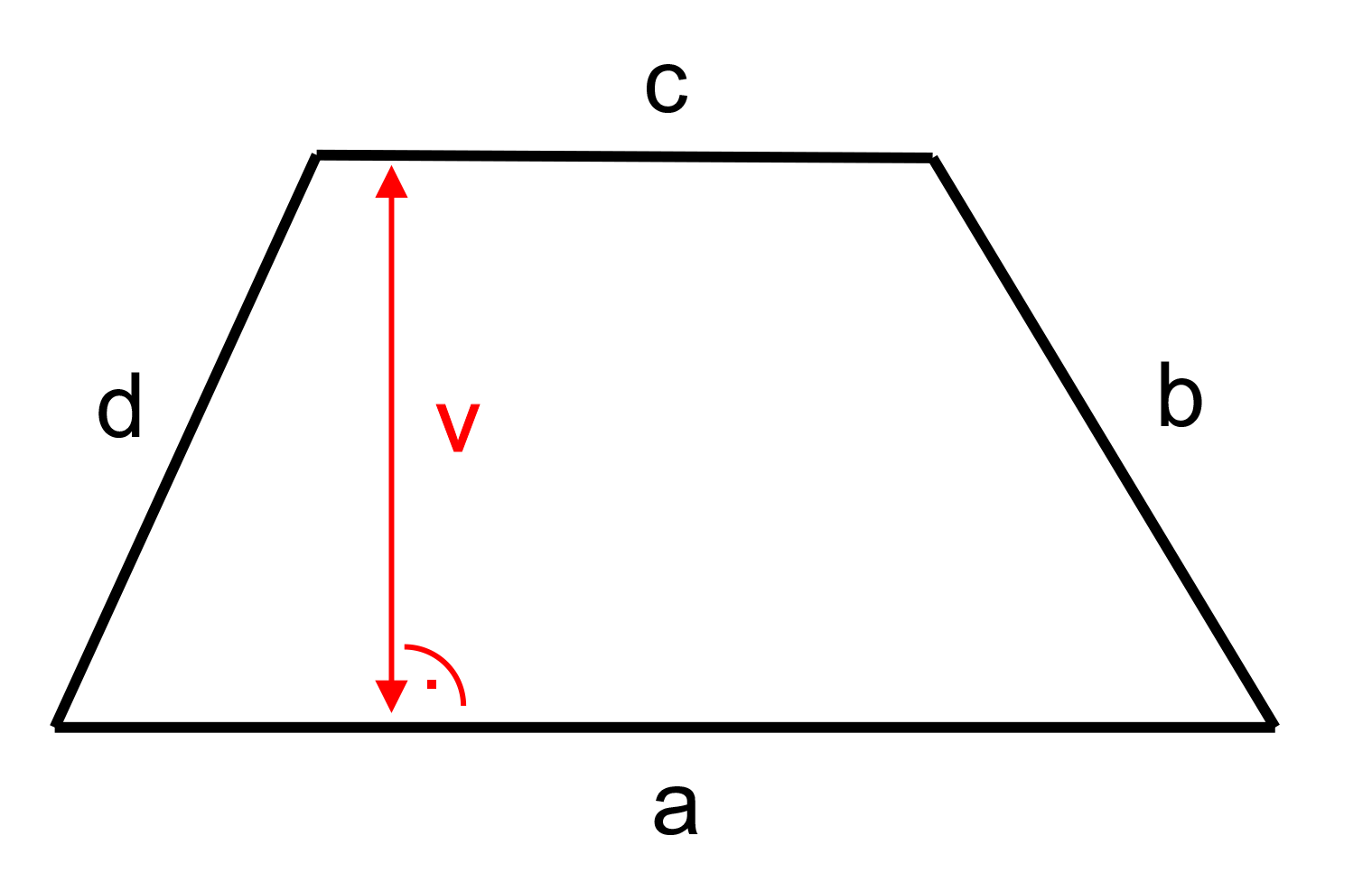
A = area
P = perimeter
a =side "a"
b = side "b"
h = height
A trapezoid (called a trapezium in British English) is a quadrilateral, a flat four-sided shape, that has at least one pair of parallel sides. Those parallel sides are known as the bases, and the two slanting sides that connect them are called the legs. Several special forms exist: an isosceles trapezoid has legs of equal length and matching base angles, giving it a symmetrical appearance; a right trapezoid has one leg perpendicular to the bases, forming two right angles; and a scalene trapezoid has legs and angles that are all different. A useful property is the midsegment, the line joining the midpoints of the legs, which runs parallel to the bases and equals the average of their lengths. Because the two bases usually differ, a trapezoid gently tapers from one side to the other, which makes it distinct from a parallelogram, where opposite sides are equal.
This shape appears constantly in the real world, from bridge trusses and roof supports to table legs, handbags, and even the profile of many dams. Architects and engineers rely on trapezoids because their sloped sides distribute loads efficiently and add stability. The shape also matters in mathematics itself: the trapezoidal rule, a method for estimating the area under a curve, is one of the cornerstones of numerical integration.
Trapezium area
–
Perimeter
–
Midsegment m
–
| Base a | – |
| Base c | – |
| Height h | – |
| Legs b · d | – · – |
Drag a vertex — both parallel sides stay horizontal Re-center
Solve it step by step — the next step unlocks only after a correct answer. You can type decimals with a dot or a comma.
