Cone - area and volume
Online calculator — enter the values and get the result instantly, with the formula and a worked example.
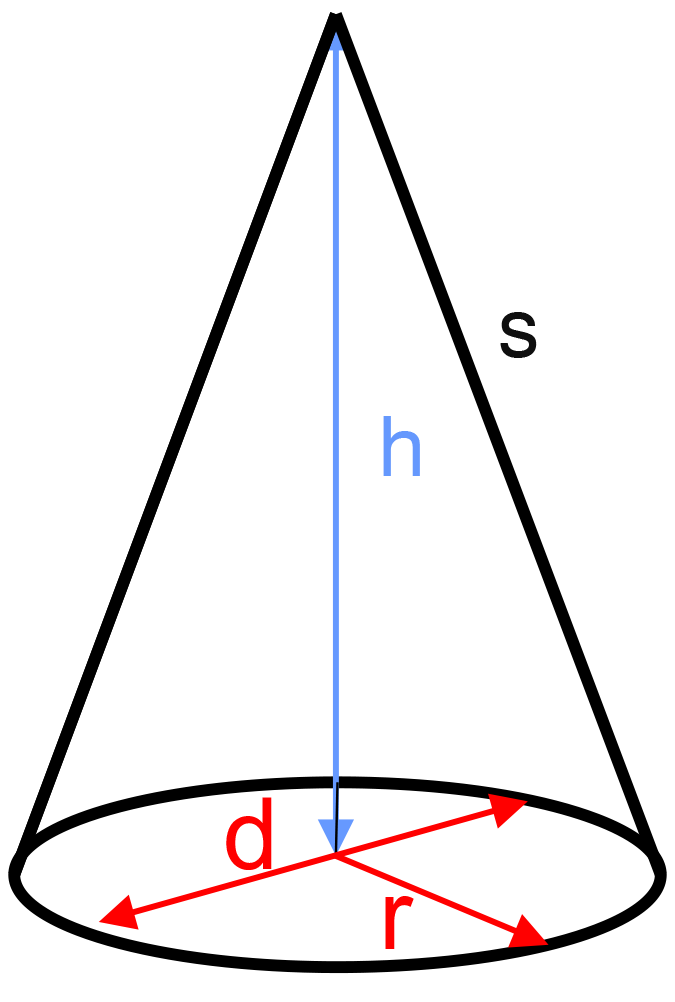
A = Area
V = volume
d = diameter
r = radius
h = height
s = slant height
A cone is a three-dimensional solid that tapers smoothly from a flat, circular base to a single point called the apex. Its shape is defined by just two measurements: the radius of the base and the height, the perpendicular distance from the base to the apex. A related quantity, the slant height, runs along the sloping surface from the apex to the edge of the base and is useful when finding the curved lateral area. A right cone has its apex directly above the centre of the base, while an oblique cone leans to one side, yet both enclose the same volume for a given base and height. That volume is exactly one-third of the cylinder that shares the same base and height, a surprisingly tidy relationship that has been known since antiquity. The total surface consists of the circular base together with the curved lateral surface that wraps around it. Cones appear throughout mathematics as one of the classic conic solids and are the basis of the conic sections studied in geometry. In the everyday world they turn up as ice-cream cones, traffic cones, funnels, party hats, and the pointed roofs of towers. Understanding the cone also helps explain how volcanoes, sand piles, and drill bits take their characteristic tapering form.
Cone volume V
–
Surface area S
–
Slant height s
–
| Base area πr² | – |
| Lateral surface πrs | – |
Drag the radius point or the apex Re-center
Solve it step by step — the next step unlocks only after a correct answer. You can type decimals with a dot or a comma.
