Cube - area and volume
Online calculator — enter the values and get the result instantly, with the formula and a worked example.
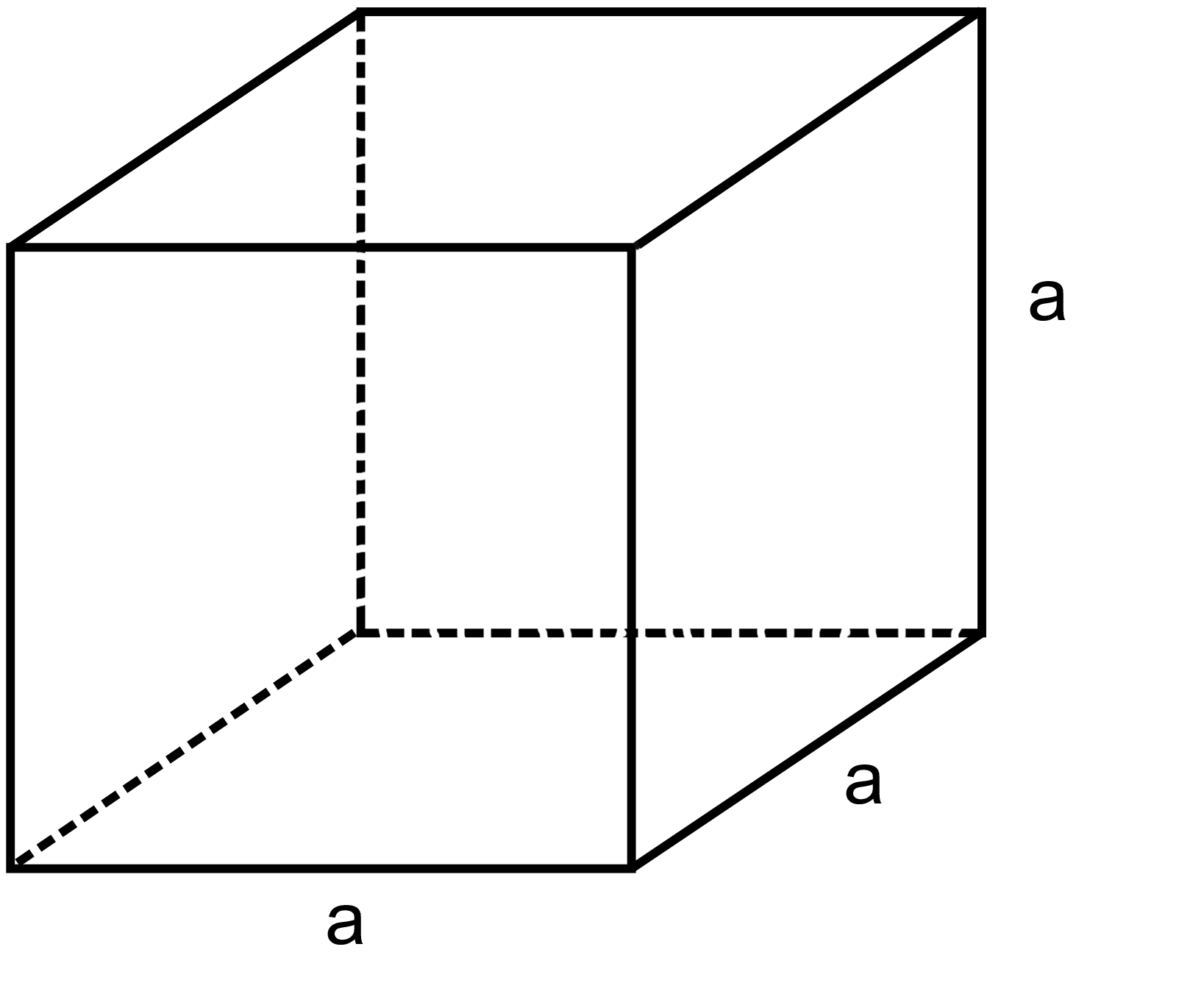
A = Area
V = volume
a = cube side
A cube is a three-dimensional solid bounded by six identical square faces, twelve equal edges, and eight vertices where the edges meet. It is one of the five Platonic solids, and its defining feature is perfect regularity: every face is a congruent square, every edge has the same length, and every internal angle is a right angle. Because of this symmetry, a cube looks the same from many directions and can be described completely by a single measurement, the length of one edge. Two key quantities describe its size: the surface area, which is the combined area of all six faces, and the volume, which is the amount of space enclosed inside. A useful hidden measurement is the space diagonal, the straight line running from one corner to the opposite corner through the interior of the solid. Cubes appear throughout mathematics, architecture, engineering, and design because they stack neatly, fill space without gaps, and are easy to measure and manufacture. In everyday life you meet them as dice, sugar cubes, storage boxes, children's building blocks, and the pixel-like voxels used in computer graphics.
Cube volume V
–
Surface area A
–
Space diagonal u
–
| Face diagonal | – |
| Sum of edges | – |
Grab a corner and drag — the cube grows or shrinks Re-center
Solve it step by step — the next step unlocks only after a correct answer. You can type decimals with a dot or a comma.
