Parallelogram - perimeter and area
Online calculator — enter the values and get the result instantly, with the formula and a worked example.
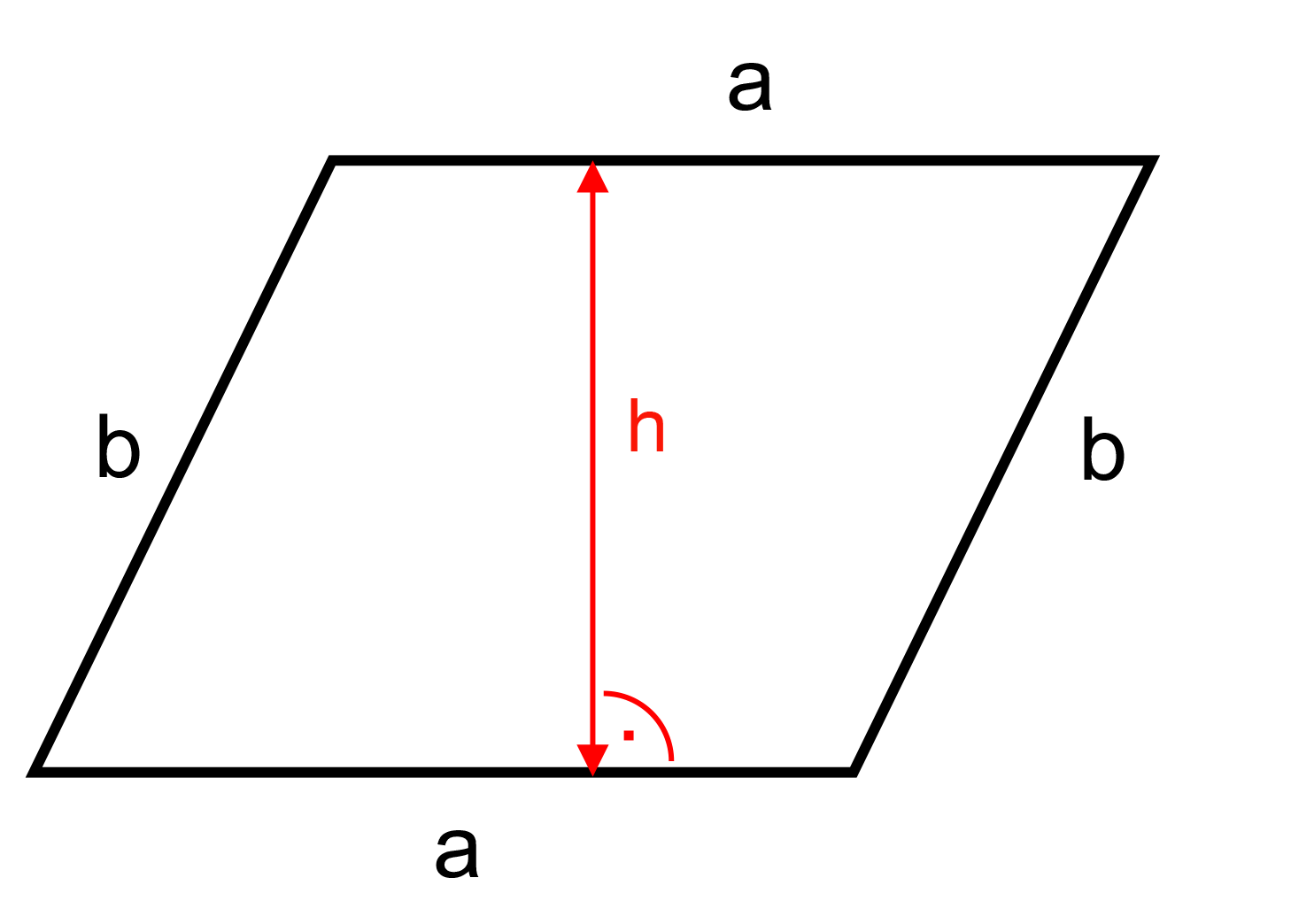
A = area
P = perimeter
a = side "a"
b = side "b"
h = height
A parallelogram is a quadrilateral in which both pairs of opposite sides are parallel, which forces those opposite sides to be equal in length. Its opposite angles are equal, while any two adjacent angles are supplementary, adding up to 180 degrees. The two diagonals cross at their midpoints, so each one bisects the other, though they are generally not the same length. Familiar shapes such as rectangles, rhombuses, and squares are all special cases of the parallelogram. A distinctive feature is that its area depends only on a base and the perpendicular height, not on how "slanted" the figure is. This slanting, or shearing, preserves area, which is why parallelograms appear throughout geometry proofs and coordinate math. They also model real situations, from the force diagrams of physics to the parallel rulers and adjustable frames used in drafting and engineering. Because of these clean properties, the parallelogram is one of the building blocks for understanding more complex polygons.
Parallelogram area
–
Perimeter
–
Side b
–
Side a
–
Height h
–
Drag a vertex — the bottom corner changes side a, the top corner changes the slant and height Re-center
Solve it step by step — the next step unlocks only after a correct answer. You can type decimals with a dot or a comma.
