Sine
Online calculator — enter the values and get the result instantly, with the formula and a worked example.
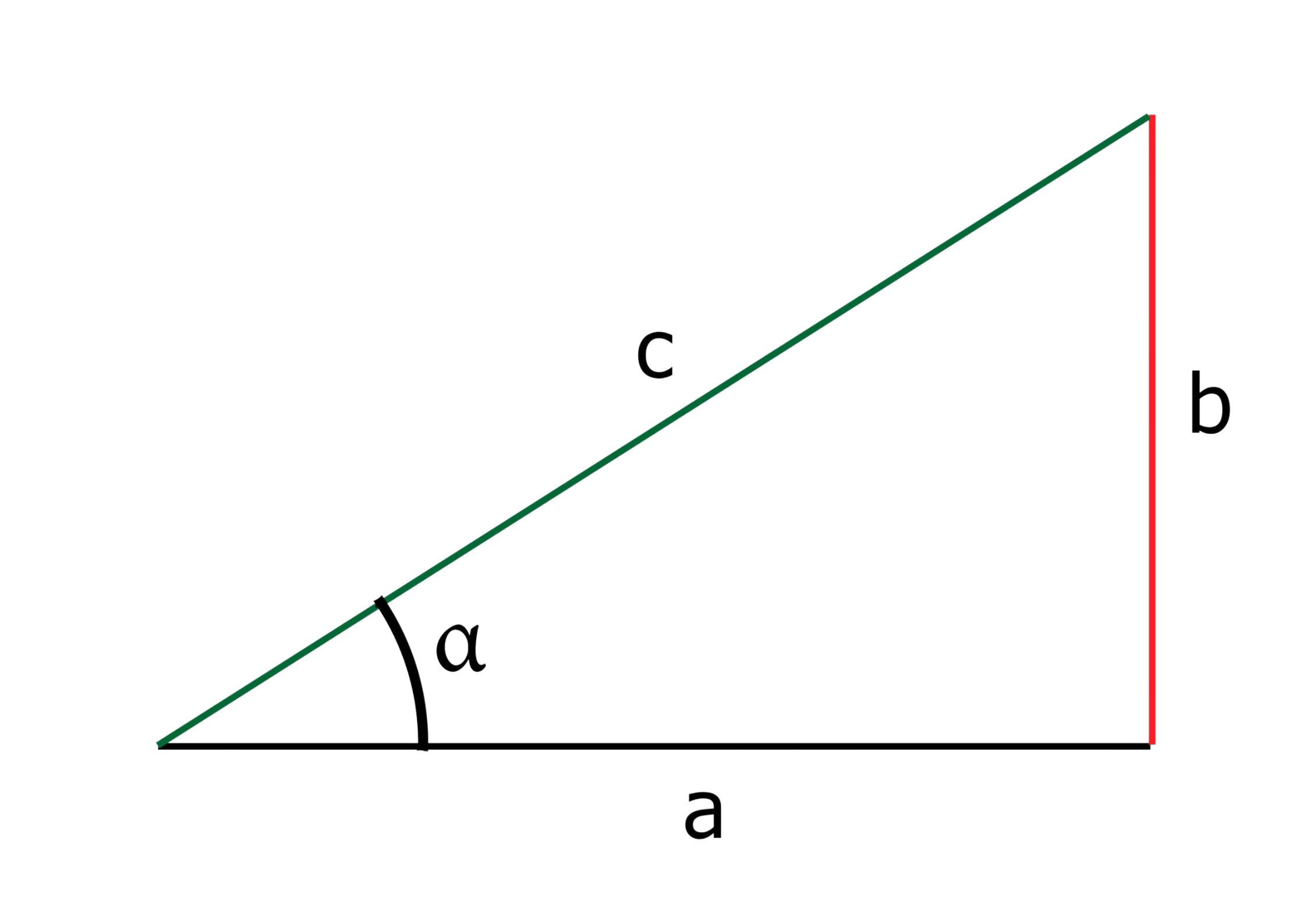
α = angle alpha
a = side "a"
b = side "b"
c = side "c"
The sine is one of the fundamental trigonometric functions, written as sin. In a right triangle it is defined as the ratio of the length of the side opposite a given angle to the length of the hypotenuse. More generally, on the unit circle the sine of an angle equals the vertical coordinate of the point where the angle's arm meets the circle, which lets it be defined for any angle, not just those inside a triangle. Its values always lie between -1 and 1, and the function is periodic, repeating every 360 degrees (or 2π radians). The sine is an odd function, meaning sin(-x) = -sin(x), and its graph forms the smooth, endlessly oscillating wave known as the sinusoid. Because so many natural phenomena rise and fall rhythmically, the sine is used to model sound, light, alternating electric current, tides, springs and other vibrations. It is also essential in geometry and navigation for finding unknown sides and angles, and in physics and engineering for describing waves and rotation. Together with the cosine it forms the backbone of trigonometry and of the mathematics of periodic motion.
sin(θ)
–
Drag the point around the circle — or enter an angle
Solve it step by step — the next step unlocks only after a correct answer. You can type decimals with a dot or a comma.
