Cylinder (circular flat) - area and volume
Online calculator — enter the values and get the result instantly, with the formula and a worked example.
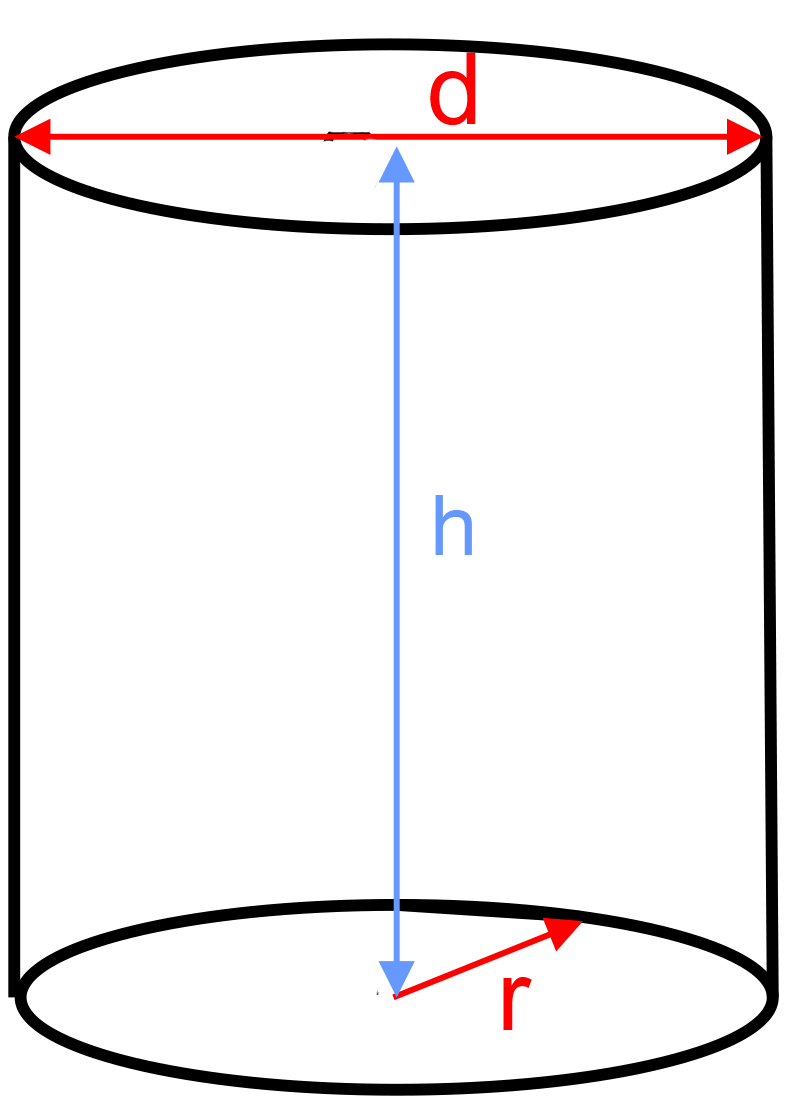
A = Area
V = volume
r = radius = 1/2 d
d = diameter
h = height
A cylinder is a three-dimensional solid formed by two parallel, congruent circular bases joined by a single smooth curved surface that wraps around them. It is defined by just two measurements: the radius of its circular base and its height, the perpendicular distance between the two bases. Because every cross-section taken parallel to the bases is an identical circle, a cylinder has perfect rotational symmetry about its central axis. Its total surface consists of the two flat circular ends together with the lateral surface, which unrolls flat into a simple rectangle. The volume it encloses grows with the square of the radius but only linearly with the height, so widening a cylinder increases its capacity far faster than making it taller. This efficient, easily manufactured shape is one of the most common in the world around us, appearing in cans, bottles, pipes, storage tanks, and mechanical pistons. Its symmetry also lets it roll smoothly and distribute pressure evenly, which is why it is favoured for wheels, rollers, and pressure vessels. Understanding the cylinder is a foundational step in solid geometry and underpins countless problems in engineering, architecture, and everyday design.
Surface area A
–
Volume V
–
Lateral surface 2πrh
–
| Radius r | – |
| Diameter d = 2r | – |
| Height h | – |
| Base area πr² | – |
Drag the point on the edge (r) or the top base (h) Re-center
Solve it step by step — the next step unlocks only after a correct answer. You can type decimals with a dot or a comma.
